

I’ve been writing some hard posts lately. This one’s going to be real hard.
I’ll begin by telling you something that fills me with anxiety to say: In the late nineties, when I was a teenager, I took an online IQ test and got 159. At the time I didn’t think much of it. I was aware the number was high, but it didn’t occur to me to look at comparison charts or otherwise seek resources about what the number meant. I also didn’t assume the test was valid.
At the time, the only person I told about my score was the gamer buddy who sent me the test website. He seemed crestfallen that my number was so high. So it didn’t seem like something I should go around telling others.
I didn’t talk about the test with my parents because I’d long since internalized a sense that we ought not to talk about IQ. My only clear memory here is a gentle dinner table lesson intimating that IQ discussions were déclassé. My parents noted, with distaste, that there were “clubs” for people of a certain IQ. It was clear that neither would be caught dead in any such club. Years later, as an adult, I would learn that both my parents tested 140-ish.
Throughout my life, everyone said I was smart. Grades were never a problem. But I was a weird girl. At school, “everyone knew” I was smart, and “everyone knew” I was not like anyone else. I got institutionalized, twice, because I kept failing to conceal how much I thought about suicide. Fortunately, my parents had once been smart strange kids. They loved me, and they generally let me do my thing as long as it seemed like I wasn’t in danger.
On days I had to persuade myself not to contemplate suicide, this was the primary argument I made to myself: I knew it would hurt my parents terribly if I died. They were good people and I didn’t want to upset them. I decided it was worth living as long as my parents were in the world.
Most teachers liked me. I was diligent, always did my homework, and took instruction well. Adults told me things would get better after I grew up, which seemed like another good argument to not kill myself. I was awkward and chronically bullied by other kids, but I told myself it didn’t matter, and sometimes I believed it.
Why did I want to die, anyway? I could not remember a time I didn’t think about dying. But I couldn’t explain why. It was confusing because people were always telling me how smart I was, so it seemed like I should be able to figure it out. Maybe I could explain if I found the right words? Sometimes I tried. In second grade, I was required to meet weekly with a child psychologist because I kept wearing black and talking about killing myself. One day I tried discussing Zhuangzi’s ideas with the psychologist; I’d gotten my little paws on Zhuangzi Speaks by Tsai Chih Chung, a graphic novel that distills the Chinese philosopher’s teachings, including the famous fable that asks whether a butterfly dreams of being a man or a man dreams of being a butterfly. The book also retells a Zhuangzi story about death and personal transformation that suggests: “Maybe death will be so great we’ll end up regretting having ever lived.” I described this to the psychologist. With an avid glitter in his eye, he pounced on the transformation parable as evidence that I might be considering suicide again. I had the sense the conversation wasn’t going anywhere good, so I stopped trying to talk about it for a while.
But I always ended up trying again. When I tried again, people explained to me that my depression made no sense because nothing was wrong. My parents were great. I was physically healthy. My school was good, my talents were nurtured, my hometown was charming. Many psychological tests were administered over the years, and no problems found aside from the depression itself. In middle school, when I made the mistake of admitting to a school psychologist that I had considered suicide, that was the first time I was institutionalized and medicated against my will. The experience was awful, so I became very cooperative — as cooperative as I could stand. It was clear that representatives of the system did not want to hear that it was Kafkaesque, so I did not tell them. Unfortunately, I couldn’t stand the therapist they assigned me, so in tenth grade I tried simply refusing to talk to her, or to anyone else for that matter, at which point I was institutionalized the second time, this time for several weeks.
Sometime around that second institutionalization, I received a multi-hour stack of tests, including the famous Rorschach inkblot test. The inkblots reminded me of the “chaos butterfly.” I said as much to the psychologist administrating the test, at which point I had to explain what I knew about chaos theory. Afterwards the psychologist told my father I was brilliant, with an off-the-charts IQ, “somewhere in the 150s.” Yet he estimated that my depression was so bad that it also depressed my real-world capacity.1
What could I possibly have done? What could my parents have done? This problem has a new urgency for me, now, because I have a child.
I think, on some level, I understood the society I inhabited was unsustainable, its shadow darker and crueler than I could imagine; yet its logic simultaneously seemed remorseless, impossible to escape. I spent most of my time reading science fiction and playing online games. In retrospect, these genres felt like a protest of the unseen. It was the nineties: My country was, in theory, doing great. Yet in my classes I learned about rapidly disappearing animal species and wartime atrocities. Adults explained to me how humans had created the atomic bomb to kill other humans with, and that we were systematically killing every other species on the planet, aside from the ones we had enslaved. Adults explained that all of us shared a responsibility to work towards social change before our unsustainable society fell apart. This diagnosis seemed obviously correct, and I had no quarrel with it, but at the same time, a cure felt unimaginable. My favorite book was Tanith Lee’s Biting The Sun, about a girl who grows up in a seeming utopia that she ultimately rejects.
The notion of a “spiritual void” was not one I considered until years later. I was raised Unitarian Universalist, among people who thoughtfully discussed different stories of God. My family went to church. As part of my religious education, we kids visited other churches; during these visits we were instructed to behave with absolute respect, and we did, because Unitarian Universalists are like that. I listened to my lessons and never got the impression that other organized religions had a better approach than UUs.
Honestly, I was one of the lucky ones: Unlike many “gifted” kids, I wasn’t friendless, and my family had resources. My parents got me numerous extracurriculars, especially art classes, which I loved. Even in public school, I was placed in a multitude of accelerated classes and gifted programs. Many told me I was destined for greatness, for leadership. One such program was the Johns Hopkins Center for Talented Youth, which operated a summer camp that kids could attend if we got sufficient test scores; CTY was the first place in my life where I felt like I fit in.
After I was institutionalized the second time for refusing to talk to my therapist, a psychologist on my case told me about Simon’s Rock College. It was a college for kids “who didn’t belong in high school.” At SRC, incoming freshmen were generally sixteen, rather than eighteen. The psychologist noted that if I applied immediately, then I could attend college as soon as next year.
My parents, who were at their wits’ end, gladly took me for a visit. Simon’s Rock College had an isolated campus in Great Barrington, Massachusetts. The small library included a lovely, quiet, tiny indoor pond with two resident frogs. During my visit, I ran into a CTY friend — he was already a student there and encouraged me to apply. By the time the tour ended, I was determined to get into Simon’s Rock, and I did.
For years, I had occasionally planned to kill myself but never followed through. For years, I told myself that if things didn’t get better, then I’d commit suicide on my sixteenth birthday, which seemed as good a deadline as any. As it turned out, my sixteenth birthday fell during the summer after tenth grade, while I was at CTY camp, so my CTY friends threw me a surprise party.
I already knew I was headed to Simon’s Rock the following year; I never had to go back to school in my charming hometown again. My CTY friends decked our dorm with party decorations and wrote me a card listing all the things they loved and appreciated about me. I thought about my old suicide plans, and I cried with wonder and joy.
—
In the year 2000, I started at Simon’s Rock.2 It’s 2025 now.
A few months ago, one of my college friends visited California. We went out for drinks. “You know, the Simon’s Rock campus is closing,” he said. “They’re selling it off.”
I hadn’t heard. I got my Bachelors over twenty years ago, when I was nineteen. Since then I’ve lived in multiple cities, traveled all over the world, achieved minor fame under multiple names, found God, had one failed engagement and one incredibly perfect son. I settled all the way across the country from Simon’s Rock, far from most alumni.
The Simon’s Rock network isn’t very large anyway, because there aren’t many alumni, even on the East Coast. SRC was founded in the early seventies; most early classes were twenty-ish people. When I was there, incoming classes were over a hundred students, but there was a high attrition rate, with one-quarter to one-third of each class departing during freshman year. Sixteen-year-olds — even really smart ones — often can’t handle college, and the ones who couldn’t, dropped out. On top of this, many SRC students transferred to other colleges after sophomore year, because transferring enabled them to finish their studies and earn their official diploma at better-known schools.3
I spent four years and got my Bachelors at Simon’s Rock. It occurred to me, talking to my friend, that I had now lived more years since graduation than I lived through my entire life before.
With so few alumni, SRC didn’t host reunions sorted by graduation year like a normal college. Instead, there was one big reunion every year, which all alumni were invited to attend. That night in the bar, my friend explained that this year, 2025, would be the last reunion on campus, and he wanted me to come. It would be huge, he said. Most years, the reunion had fewer than fifty people; this year, he said, seven hundred had registered.4 It was completely sold out. Still, he wanted me to come, and it would be trivial to help me sneak in. My friend had gone on to a respectable career in intelligence after college, so when he said he’d sneak me into our sold-out college reunion, I believed him.
So in June, I flew into Boston, rented a car, and drove three hours to the Berkshires. I’d never done the drive before, because I didn’t learn to drive until I was in my twenties; I would have learned in Drivers’ Ed, which is where most Americans learn to drive, but Drivers’ Ed is typically parceled with junior year of high school and I was already in college by then. Also, back when my family drove me to campus, it always happened from the New York side, because that’s where my family lived. Thus, my drive from Boston felt weirdly symbolic: I now have vastly more capacity than when I was in college; and I approached campus from a different direction.
On the drive, Spotify surfaced DJ LP Giobbi’s song “All In A Dream,” with lyrics about signs and symbolism. Spotify was founded after I graduated, and “All In A Dream” is a recent song, yet it felt well-suited to this strange nostalgia. I kept hitting the back button to re-listen until, finally, I put the song on loop and left it there. It was playing when I crested the serene green hills, watched the sun setting over a loose and picturesque fog, and finally drove along the minor back road that leads to Simon’s Rock.
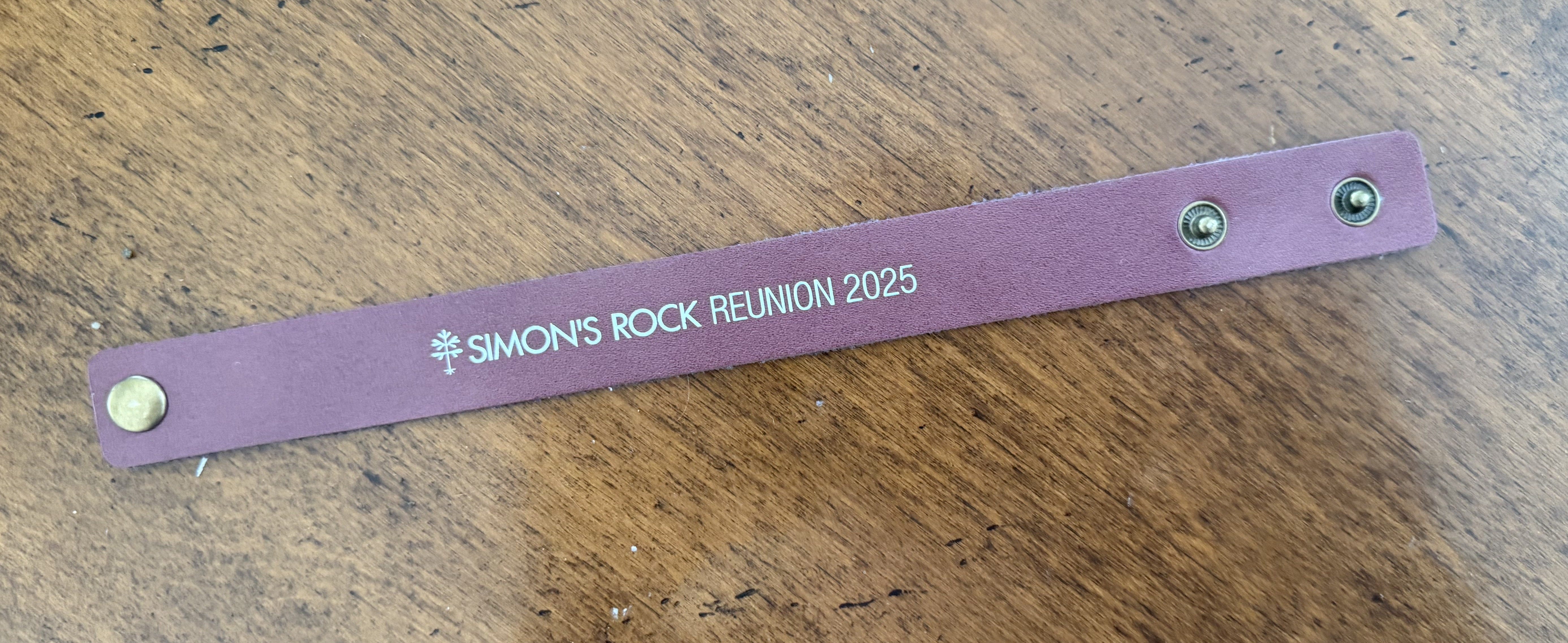
Entry was trivial. There was no security whatsoever, not even a moveable roadblock. I parked with everyone else, and my friend came to meet me in the gathering dusk, with a spare wristband he’d surreptitiously snagged on my behalf. I had forgotten how isolated the campus was and how, in so many ways, it relied on security through obscurity.
—
The Simon’s Rock logo is a hemlock leaf, for Socrates. Signs bearing that symbol were all over the beautiful campus.
So beautiful. How had I forgotten? I spent four years there…
Rolling lawns, wide open sky. A wood-and-rope swing, hung from a tall old tree. A pond beside a winding wooded path. On the night I arrived for the reunion, my friend and I walked along the path, and saw fireflies.
“Do you remember…”
Simon’s Rock students basically never left campus. We formed our own tiny pocket reality. Few of us had cars. The college operated a shuttle some students took into the village, to buy groceries and such, but most of us ate what was served in the dining hall.
The curriculum was absorbing, the classes interesting. Class sizes were mostly small, around fifteen to twenty students. I majored in philosophy, religion, and studio art.5 (I studied Zhuangzi in one of my classes, and gave the teacher a copy of Zhuangzi Speaks.) Many teachers were lifelong SRC professors and loved their jobs. The only exception I could recall was a teacher who stole several of my roommate’s papers during our freshman year and published them under his own name, to academic acclaim. My roommate and I thought this was dumb; we made fun of him to our friends, but we did not bother reporting him to anyone in power, and he gave us good grades for not doing so. Aside from him, our teachers were great.
As we walked through the birches and fireflies, my friend asked if I recalled the pranks we used to play. One time, we staged an elaborate show in the parking lot, where prospective students would see it during their tour: A large expressionless male student, wearing a black suit and with a briefcase handcuffed to his wrist, surrounded by students wearing sunglasses and leather jackets, pretended to do a surreptitious handoff, then peeled out of the parking lot. Another time we performed a “coup” on the administration. We tried them for crimes against humanity and punished the provost with a slap on the wrist.
At Simon’s Rock, there were three basic categories of student. One category had the ability to get into SRC, but couldn’t make it work for themselves; they almost all left freshman year. Then there were the ones who Had A Plan, who openly burned with a need to Achieve, the kind of people who started a business at age twelve, who attended college solely to check the diploma box so they could go on to Win Everything As Soon As Possible. They invariably transferred out of SRC after using it to get their foot in the college door at age sixteen, because transferring enabled them to get their all-important piece of paper at Harvard or Yale. I admired their focus and drive, but I felt affectionately bemused by their goals.
The third category was kids like me. I think, mostly, we were glad to be somewhere that felt emotionally safe. Mostly, we performed our minor acts of disobedience with respect for the container that held us.
My friends and I devoted our free time to roleplaying games like Dungeons and Dragons, or more importantly, indie alternatives like Vampire and Exalted by White Wolf Game Studio. I wrote my senior thesis about roleplaying games: It started with a sixty-page scholarly (“scholarly”) discussion of game design; then it had two hundred-ish pages of fanfiction, plus calligraphed insets for which I designed original fonts. I got Honors on that thesis. For years afterwards, I maintained a copy on the internet and received fan mail for it. After graduation, my first regular writing job was with White Wolf.
“I don’t have a hard copy of my senior thesis,” I remarked to my friend as we walked around the pond at the last SRC reunion. “But since campus is closing anyway, maybe I’ll go steal my thesis from the library?”
“Well, technically Simon’s Rock College is continuing elsewhere,” said my friend. (Technically. We both knew it wouldn’t be the same.) “So they already moved all the theses off campus, before the reunion.”
The administration had anticipated this entire thought process. “Ah,” I said ruefully. “They know us,” and we both laughed.
I thought about the school’s security. I felt so safe, back when I was a student. But were we safe — this unruly mass of weird, clever, often disobedient children, alone together in the woods? Simon’s Rock had one of the very first school shootings, in 1992, eight years before I arrived, back in the halcyon days when school shootings were incomprehensible and rare. Later, when I was a student, I heard that a kid got expelled because the admin found materials for a pipe bomb in his closet.
Much later, during the 2025 reunion, I met a young woman who told me that in her cohort, many believed the campus was sold because too many students committed suicide. Too many bereaved parents sued the school, she said.
To me, when I found it, SRC felt like a lifeline. I’d been just about suicidal before I got there. It didn’t feel like hyperbole to say that SRC saved my life. But was it plausible that the school made things worse for other kids? I had to admit, if I’d been determined to commit suicide at Simon’s Rock, I was not sure the administration could have caught me in time.
I thought back to freshman year. When I arrived at SRC, I was heavily medicated, taking multiple pills every day. Throughout freshman year, when I explained this to my friends, they had one of two reactions: Either they thought it was understandable, generally because they knew others in the same boat; or they thought I ought to get off the meds immediately.
I remember a girl sitting on my dorm room bed and saying: “We have no idea what these medications do.” Another student, a boy I was madly in love with, told me: “I will never know who you really are, as long as you’re on that stuff.”
—
As early as elementary school, other kids liked to make fun of me for being “crazy,” based on facts like: 1. I read a lot of books, 2. I never watched popular television, and 3. I had pet ferrets — clearly a “weird” pet and not a “normal” pet. Their mockery escalated into a game wherein a group would find me on the playground and jump me. They’d say, in singsong voices, they were taking me to the “looney bin;” they’d tell me I was about to be locked up forever. Inevitably I’d start to cry, and the other kids would point and laugh at me until they got bored and did something else. I don’t know who invented this game or why. I guess they liked it, given that they did it more than once.
At the time I felt helpless. In the decades since, I’ve often wondered if I could have done something to escape the bullying. In my twenties, I ran across an essay by well-known Silicon Valley investor Paul Graham, “Why Nerds Are Unpopular.” Graham’s thesis is that young nerds are unpopular because, instead of working on popularity, we prefer to work on activities related to “being smart.” Graham argues that nerds have the power all along to save ourselves from bullying, but we effectively choose not to.
Is that true? Maybe I could have tried harder to fit in. Would it have been worth it, if I’d tried? I’ll never know. I often felt like there was something ineffable that made me myself. Maybe I cared more about preserving the “me” quality than fitting in. Maybe that means I was at fault, in a sense, for all of it. Who knows.
Anyway, years after playground bullies devised the “take her to the looney bin” game, I found myself in the actual looney bin.
The first time I got institutionalized was not so bad. I was in eighth grade. They let me out after a single night, having extracted a promise that I’d take medication and attend therapy, which I obediently did until the fateful day in tenth grade that I stopped talking to my therapist.
The second time was much worse. I had a single core fear: This time, they’d never let me out. I was fifteen years old and I kept thinking that somehow, despite all my attempts at obedience, I’d crossed the final line. I sat in the sterile ward crying, and crying, and crying, for hours.
A doctor I didn’t know came to see me. He tried to get me to explain myself, but I could hardly speak through the tears. “I’m going to give you a pill to calm you down,” he said eventually.
A sedative. The doctor was about to give me a sedative. “No,” I gasped. A vision flashed before my mind’s eye: Me, drugged into oblivion, a compliant thought-free robot, not even allowed my private sadness.
“Then you have to stop crying,” the doctor said, in a reasonable tone.
To my own surprise, I stopped. There was a moment of silence between us. Then the doctor nodded once, and he left me alone.
My father came to visit me. I think he didn’t believe I belonged there, but he was up against the entire machinery of mandated reporting,6 of experts telling him his baby girl was likely to kill herself, which, to be fair, was not an impression I’d done a good job contradicting. “I’m going to get you out of here,” he promised grimly. My mother came separately, with a stack of science fiction books. Mom didn’t read science fiction herself, so she’d gone to the bookstore and asked for recommendations. Her eyes were bright with unshed tears as she advised me not to think about where I was. “Lose yourself in your books,” Mom said. So I curled up in bed and read, as much as the staff would let me.
After a while, I talked to the staff. I was good at bonding with authority figures when I tried, and the mental hospital staff were no exception. A security guard explained why so many of my possessions were taken away: My spiral-bound school notebooks, for instance, might have the wires removed, at which juncture I might use the wires to kill myself. So that was why they took my notebooks. I had to admit that it made sense. “I once saw a guy try to choke himself to death with double-D batteries,” the guard confided.
I dodged the sedatives, but within a week they told me I needed extra daily medication. Pretty soon I believed it myself.
Weeks later, when they finally let me out, I diligently continued taking my pills. There were significant side effects: My thinking felt fuzzy; I slept all the time. Throughout that time, I generally required fourteen hours of sleep per night. Sometimes I randomly fell asleep during the day. I learned to give adults an authentic-flavored mix of true personal growth and self-examination, with minimal challenges, few inconvenient questions, no tears. I never forgot the moment when I was crying, and the doctor threatened me with sedatives.
Now that I’m a parent, this system seems almost comically awful — and also tragically understandable. But before I attended Simon’s Rock, I never allowed myself to think that maybe, just maybe, by institutionalizing me and stuffing me full of non-consensual psychotropic drugs, our society’s institutional medicine did something bad. It was my SRC friends who started me down the path of seeing that system in a different way.
I would deal with the system again and again in the ensuing years. Eventually I voluntarily did therapy with new therapists, some of whom I came to like. Eventually, years after graduation, I joined the Peace Corps and received a mental health evaluation that cleared me for its emotional challenges, which felt like a personal victory. It would be decades, however, before I spoke to a psychologist who said to me, very clearly: “What happened to you as a teenager was wrong.”
—
So, anyway. At age seventeen, around the beginning of my sophomore year at Simon’s Rock, I stopped taking my prescription. I didn’t tell anyone I was trying to stop until it was done. I knew I was addicted, so I transitioned off the pills slowly, not all at once. It took a few weeks.
I had been told that these medicines were necessary. That without them I was at risk of catastrophic mental breakdown. That without the meds, I ought to be incarcerated for my own protection. And yet when I went off the meds, I was… fine.
In fact, I felt great! I no longer had to cope with a ton of side effects. I could stay up super late with my friends, and stay alert through my classes, and…
I was…
happy?
I
was
happy.
I didn’t tell the adults I’d gone off the meds because I was afraid they’d lock me up again for noncompliance. Once I turned eighteen and was no longer a minor, I planned to admit to them that I’d been off the meds already for a year. (After I turned eighteen, I did.)
However, this created an odd social problem. I had long resisted taking psychedelics with my college friends; when I arrived at SRC, I was what we used to call “straight-edge.” A minority of my SRC friends were straight-edge too. But others, who loved taking psychedelics, now pointed out to me that the psychotropic drugs imposed upon me by the medical system were not more legitimate than mushrooms or LSD. I didn’t have a good argument contradicting this. So after I stopped taking my prescribed medication, I started trying psychedelics at age seventeen. Illegal drugs were as easy to get at SRC as alcohol; almost all the students were underage, so we were breaking the law either way.
The first time I took mushrooms I saw God in student housing. It was beautiful and awe-inspiring. I wept. Before this, I was an atheist. When I came down, I was an agnostic.
In the decades that followed, I tried many other drugs and became part of the broader psychedelic movement. At heart, I was still the “good girl” I’d always been: I diligently advocated for safety practices; I volunteered within the movement as a psychedelic crisis counselor. Years later, I published a psychedelic safety guide in my magazine, and I have an interview here on Substack with someone who suffered a psychotic break and later created alternative mental health resources within the psychedelic community. (Similarly, when I eventually got involved in the BDSM world and wrote about sexuality, I advocated for strong consent practices and safety rules.) Eventually, I started having spiritual experiences that didn’t involve substances. Eventually, I stopped taking psychedelics at all.
Would I have gotten involved in any of that, were it not for Simon’s Rock? Looking back, I think I was likely to get swept up in the counterculture tide no matter what happened; most colleges these days have psychedelic communities. Would I have been better off if I never took any substances at all? It’s impossible to know. But either way, I think my trajectory is best understood as beginning with the medical system, rather than with the purveyors of psychedelic drugs.
Do I think psychedelics are as revolutionary and transformative as they are sometimes advertised? Honestly — no. Do I think they’re potentially dangerous? I absolutely do — I know people who died or whose lives were destroyed through the use of illegal drugs. Some people really should not take these substances, and they need help to stop. But, at the same time, do I think the psychedelic community can be framed as a better alternative to the mainstream mental health system — which is how many community members frame it? Maybe. Maybe, for many people, it is.
Much of my life, both during my studies at SRC and after, was spent rejecting the mainstream in ways large and small. Everything “normal” made me feel like a cornered animal. “Normal” was the kids who used to jump me on the playground. “Normal” was the doctor who tried to sedate me as I cried in a manner inconvenient for him. When people used the word “normal,” I felt determined to do whatever was not that. In 2025, at the last SRC reunion, one of my college boyfriends teased me about how he insisted on taking me to a school dance, and I insisted on wearing a red-and-gold Renaissance-style gown,7 and I was so annoyed by the “normie dance” that I refused to smile in the photos.
It’s funny, though, because I tried, and I still try so hard to be an actual good girl, in so many ways. Still. And these days I live a pretty normal life. I don’t take any illegal substances. I keep my home quiet and pretty and reasonably clean. I have a collection of lovely teas, and a sweet little boy who I adore. What bothers me about “normalcy” is none of the activities it supposedly comprises but rather, the hypocrisy: The fact that nobody is “normal,” at all.
I never wanted to be normal. But I have wanted to do something useful, to help others, to put my alleged gifts at the service of my society. A challenge, here, is that the most important work in the world is generally done for free or cheap. Often I feel like my main problem in life is finding work that feels interesting, challenging, also helpful and non-evil: Work where I never have to lie; work where I never have to pretend it’s good, not to others and not to myself.
But what in this world is untainted by evil?
If I’m so smart, then why has it been so hard to figure out how I can contribute, correctly, to civilization?
—
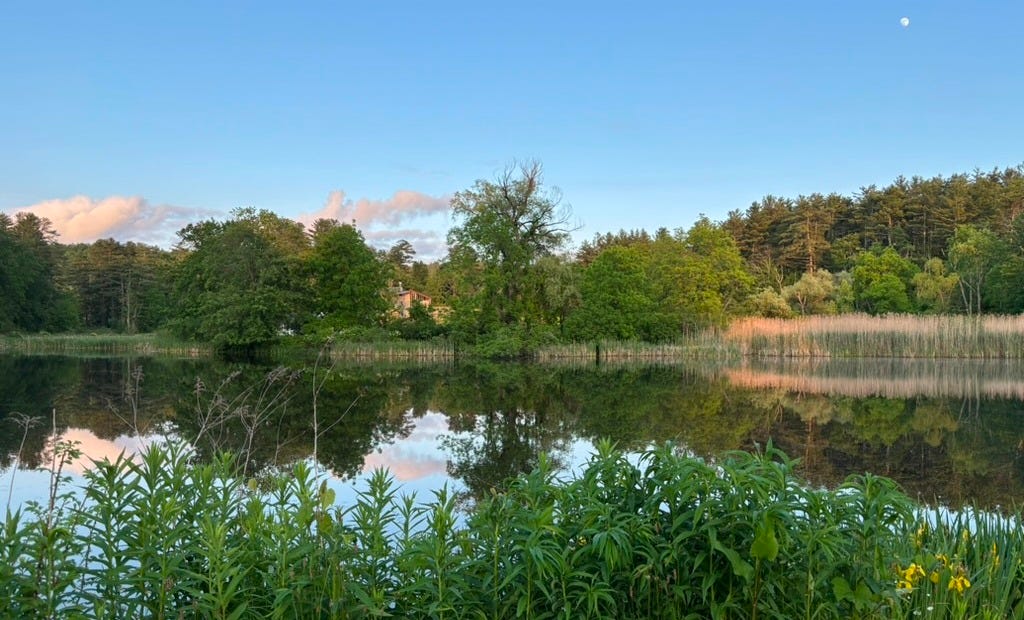
On the second day of the 2025 reunion, I walked out by the pond again, this time in sunlight. I sat on a bench where I used to sit twenty years ago and stared across the water, as the sun shaded into dark gold.
The art studio, a New England-style red barn, was behind me. I thought about how, one weekend my senior year, a friend and I took mushrooms and snuck into the studio and painted a wild mural directly on the wall with the words “Reality is the mind of God.” We were nervous we’d get in trouble, but no one mentioned it. The administration had it painted over, flat white, by Monday.
A Simon’s Rock sign stood behind me at the crossroads next to the art studio, with our stylized hemlock leaf. Socrates, corrupting the youth.
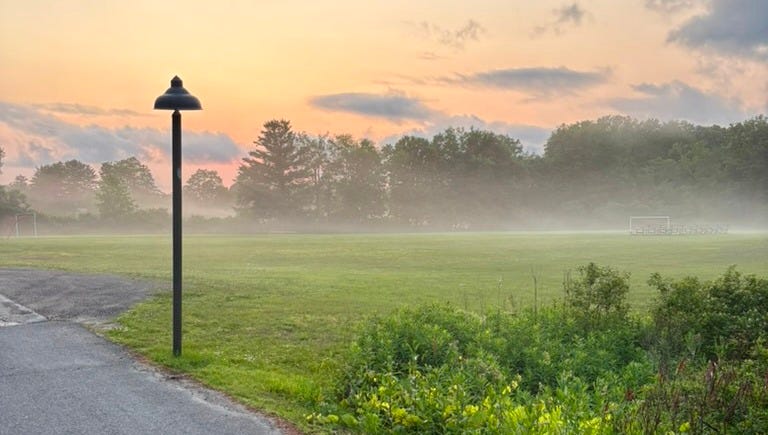
I walked back slowly, watching fog roll in across the soccer field.
On the path I ran into an older man I’d never met. He was wearing a spectacular shirt with shiny golden roses; I complimented the shirt, and we stood and chatted. He’d been drinking, but was coherent. “So,” he asked, “were you a lifeboat?”
I instantly understood what he meant. The question could have been asked like this: Did you come here in order to escape something?
“I don’t know?” I said. “I don’t know if I count as a lifeboat,” and I told him about my circumstances before I came to SRC.
He laughed. “That counts,” he said. “I’ve been learning this weekend that more of us were lifeboats than I realized, before.”
I asked after his own story. He’d been a disruptive kid, so difficult that his family didn’t know what to do with him. In the late seventies, when he was a teenager, they sent him to stay with a hard-bitten, leather-jacketed uncle who carted the kid around to his other appointments. The uncle dragged the kid along to a hangout with a buddy: A teacher at Simon’s Rock who previously taught in the city, who’d helped the uncle get a degree and transcend a background of knife fights and climbing razor-wire fences. While the uncle caught up with his old teacher, the kid got bored and skimmed books lying around the office, then started asking questions. At which point, both adults suddenly started paying more attention to the kid.
“When I started asking questions about the books, the teacher said, let’s test him,” the man told me. “They tested me. Then, at the beginning of the next semester, I got a call, and they told me to come to Simon’s Rock.”
“What was the test?” I asked. “An IQ test?”
He shrugged. “I don’t know.”
His entire life changed from there. He’d graduated. Gotten married. He had kids. “I made it,” he said, laughing. I heard the tears behind the laughter. He had peers in his class who sent their own children to Simon’s Rock. What greater investment could exist? Now none of us would ever see this place again.
—
In my thirties, at a party in San Francisco, I met a psychologist specializing in “giftedness.” I didn’t tell her about my background, but she guessed it within the first few minutes of conversation. She explained that she grew up on an island, born to parents and surrounded by people with normal IQ scores. Until she went to college, she felt like a space alien. This experience was why she chose the professional specialty she did.
The psychologist told me several things that stayed with me. IQ is measured in points, but what matters more is standard deviations; each standard deviation is fifteen points. She explained that the main thing that helps a kid with a high IQ stay grounded is sane parents and mentors who are within one standard deviation of the kid. The other thing that helps is a community of peers, other kids, who are within one standard deviation, or as close as possible.
This was the first time my childhood isolation and emotional struggles became linked, in my mind, to my IQ. Previously, I’d more often separated my unusualness from my IQ score. I knew about the mythology linking brilliance to madness, of course. But I thought of it as, merely, mythology.
Another thing I heard over the years — I can’t remember where I picked this up — is that, when high-IQ kids get placed in educational programs, it’s helpful to have a same-age cohort. This was my experience with Center for Talented Youth, the summer program I mentioned earlier, and it was also my experience with Simon’s Rock. However, it is not the experience of kids who skip grades. And it’s not the experience of kids under eighteen who matriculate early at a standard college, which happens for some high-IQ teenagers. Over the years I’ve made friends with people who attended college early under different circumstances from mine: People who attended Harvard’s summer program, for instance, or who got into “normal” colleges at a young age. It’s obvious that they had a worse experience, or maybe it’s only obvious to those of us who can relate.
All of this is relevant to Simon’s Rock because I believe it matters, a lot, for high-IQ kids to have a place where they’re surrounded by kids at similar standard deviations. It matters to create a group, a cohort. It may not matter for “lifetime achievement” or “success,” but I promise, it matters.
I’ve been told that the SRC administration perceives their mission as equally well-served by developing programs wherein sixteen-year-olds get placed on normal-age college campuses. I wish they, and similar programs, would focus on creating cohorts instead. But I don’t expect the SRC administration to stop doing whatever they’re doing now, and so I’m not writing this for them. If you are a high-IQ kid or a parent to a high-IQ kid, or someone else who genuinely cares about our emotional experience, then I’m writing this for you.
—
It was in bits and pieces, over decades, that I learned about inconvenient women being medicated and imprisoned. There is fiction about it, like Charlotte Perkins Gilman’s 1892 classic “The Yellow Wallpaper,” a famous horror story that I read exactly once and have never been able to force myself to read again. And there are many stories, as bad or worse, that aren’t fiction.
A woman’s role can be its own, less dramatic prison. My paternal grandmother, like me, went to college at age sixteen; afterwards she took a federal aptitude test and scored second place out of the entire nation of America, but was not offered the job that would have been offered, had she been a man.8 My maternal grandmother spent a lifetime as a local librarian in Ohio, and resented it, her entire life. My mother was widely considered gifted in her home community, but she grew up in poverty and believed the best way out was for her to marry for money, and so, in the mid-sixties, she did. She then ran away from her first husband, who was not my father, a couple years later.
I am one of the lucky ones.
For most of my life, the fact that my IQ might be in the 150s was a fact I only thought about intermittently, generally when people around Silicon Valley tried to intimidate me by telling me they’d scored in the 140s. It was easy for me not to react when other people bragged about their high IQs, but I didn’t think about how statistically rare my own might be. It was not until my late thirties that I thought seriously about my relative IQ score. It happened randomly, one day, while I was surfing social media and skimmed past a post by a far-right guy who said that women of IQ 160 are so rare that they ought to get state subsidies to breed. Wait, I thought. How rare is it? So I looked it up and learned that, if the tests I took in school were correct, then I am one of only a few thousand women on the globe who have tested at this level.
I thought about it a lot, after that. It felt weird, and I didn’t want to get too arrogant, but nonetheless, my mind cycled around the topic over and over. I felt alone with it, but I didn’t know who to discuss it with; many people who are openly willing to discuss high IQ are not people I want to discuss it with. Anyway, I told myself, maybe the tests were wrong. I recalled stories I’d heard over the years about bad IQ tests and poorly-constructed standards.
I thought about the mind, the psyche, and about what might or might not be true about me underneath the sign, the symbol, of the IQ test. I tried to figure out if I had any desire to get the “real” number, and in the end, I made no attempt to do so.
I thought about the enormous effort I’ve expended in search of good, useful work that’s the right match for my mind and personality. I thought about the number of my fellow Simon’s Rock alumni who ended up in relatively “low-level” jobs; it might be the majority of alumni, in fact. I thought about dollars and cents, and dollars and sense, and what money can and can’t buy.
I thought about the number of people who, after I improved my social skills, dismissed me as a hair-twirling socialite. I thought, too, about the number of men who negged me over the years by suggesting I was dumber than them. I thought about my ex-fiancé, whose IQ is extremely high; I contemplated the inarguable fact that, inasmuch as there is concrete evidence proving I am an idiot, my past relationship with my ex is Exhibit A.
I considered how much I love my son, and how much I love motherhood, and how I hope to have more children, and I also considered the way motherhood — at least in our society, and especially for women who want to work — can be a prison. In particular, the traps of single motherhood consign many a betrayed woman to nothingness. I am lucky to live in an era — and a nation — wherein single motherhood is relatively survivable.
I ask you, reader: What are women for?
And what is intelligence for?
—
On the last day of the Simon’s Rock reunion I awoke to quiet birdsong at my off-campus Airbnb, overlooking the river, a window open beside my bed. I savored the village quiet, the intermittent sounds of nature, the humid East Coast summer heat. Then I went to brunch on campus and said goodbye. Someone brought temporary tattoos of the hemlock logo, so I put one on and wore it as I drove away from Simon’s Rock, probably forever.
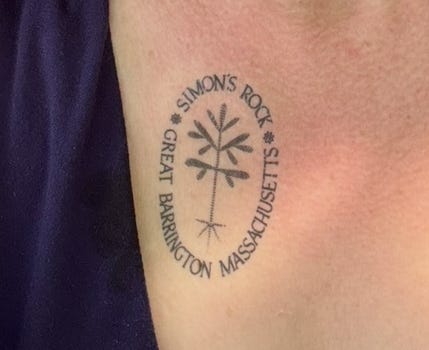
Socrates killed himself by drinking hemlock. He wielded the poison with his own hand, after a jury sentenced him to death for “corrupting the youth” with his philosophical ideas, his inconvenient questions. A strange icon to choose, perhaps, for a school of gifted, troubled kids. But I understand why the founders of Simon’s Rock chose it. What else, across the history of our civilization, symbolizes intellectual integrity so strongly?
And yet: Is it the best use of the intellect, to ask forbidden questions? Especially when those questions lead to your own, entirely predictable, self-destruction? I don’t know.
I don’t know.
My thoughts of suicide are rarer now, for multiple reasons. One is that I grew up and studied spirituality and, eventually, found other ways to understand reality, to experience the psyche, to know the soul: There are so many more ways to be human than dreamt of among dominant philosophies of our age, whether those philosophies are those of the mental health-industrial complex or of organized religion. More prosaically, my parents are still alive, and I have friends who I love. And I have a son, and I cannot bear the thought of leaving him.
As I drove away from Simon’s Rock, I put on “All In A Dream” and listened on the way to the Norman Rockwell Museum, which was only fifteen minutes away. That day, looking at Rockwell’s art, I thought a lot about America and our mythology, and I thought about how I never went to that nearby museum during my undergraduate studies, despite the fact that one of my majors was art. In retrospect, it seems to me that I was oddly incurious about the outside world when I was an undergraduate. It was rather different from the approach I took soon afterward, in my twenties. As if I emerged from a chrysalis.
Socrates was not allowed to choose the method of his execution, but historians say that he went without a struggle. They say he chose death over exile. That he chose death because he believed in accepting his punishment, in obeying the law.
If you think merely being brilliant is enough to make a person successful — or even good at surviving — then you haven’t met enough brilliant people. On the other hand, what is survival? What is success?
Plato wrote in the Apology that, when Socrates spoke to the judges, he forgave them their verdict and said: “No evil can happen to a good man, either in life or after death.” And at the end, the very end, the great philosopher asked this favor:
“When my sons are grown up, I would ask you, O my friends, to punish them; and I would have you trouble them, as I have troubled you, if they seem to care about riches, or anything, more than about virtue.”
—
•
—
Update, 9/25/25: I made a few slight changes to the text of this post for clarity and style. I also want to thank everyone who has reached out, publicly and privately, to talk and share their own stories. I am really grateful.
Update, 9/27/25: I posted more pictures I took at the reunion on Instagram.
Update, 4/26/26: Today I published a new relevant post, “Geniuses and Genius Babies,” which contains further thoughts on IQ, and “genius,” and community, and politics.
Update, 8/26/26: Some slight changes to the language around suicide, Socrates, et cetera, towards the end.
Text change made 9/30/25: This sentence originally read: Yet he also estimated that my depression was so bad that I functioned regularly at an IQ (a “performance IQ”) 30 points lower than it would be if I weren’t so sad all the time. I changed this sentence after getting a comment from Jonathan Toomim with further information about the meaning of “performance IQ.” See comment section below.
Simon’s Rock was founded independently but is now affiliated with Bard College. I have heard that this is due to an incident where Bard bailed out SRC financially, long before I got there. When I was a student there, the relationship between the two schools was minor, but Bard eventually renamed SRC to “Bard College at Simon’s Rock” after I graduated. Many alumni, including me, objected to this change, not least because Bard has a very different vibe; so we didn’t feel that Bard is a good representation of the education we got. In my experience, SRC was more similar to, say, the University of Chicago, than it was to Bard. This is why I still refer to SRC as Simon’s Rock.
A plurality of SRC transfers ended up at the University of Chicago. This may have been partly because the Chicago core curriculum was extremely similar to the Simon’s Rock core curriculum.
This was probably the largest number of people ever on campus all at once. In a typical school year when I was studying there, the campus only contained four or five hundred people total, including all the students and staff.
This was two majors, not three: One was officially called “Philosophy, Religion, and Theory,” and the other “Drawing, Painting, and Printmaking.” The Simon’s Rock administration generally seemed to feel that a bespoke curriculum was good and they made it easy for people to double major. Later, after I was done, the school split Philosophy and Religious Studies into two separate majors.
The laws of “mandated reporting” are intended to prevent harm by requiring people in certain positions to report up the chain if they observe situations where a vulnerable person can come to harm. Psychologists, for instance, are required to report anything they observe to the authorities if it leads them to believe a given person might harm herself or others.
The gown was by Jeannie Nitro. I got a deal on it on eBay, because this was back when eBay was awesome.
My dad says they called her back during World War II and offered her the job, because all the men were fighting, but she chose to stay in her community and work with the Red Cross.
Having a same-age, equally gifted cohort is so important. I was in an excellent gifted program through 8th grade. I was the best student in my class, but only had a couple of friends. For high school, I went off to a public boarding school for math + science nerds. I was no longer the top student -- far from it -- but I finally had a normal social life. My roommates and I stayed up all night playing video games and listening to illegally downloaded mp3s. I dated a boy who I met on the math team.
It's sad how California has turned away from gifted education. My husband grew up in California and didn't have any friends until he started in a GATE program in 4th grade. He's still good friends with his GATE classmates. Today, GATE doesn't really exist. Even if a district has a process for identifying gifted kids, they aren't pulled out into a separate class or program. They don't get to meet their peers until high school or maybe even college.
I understand that the public schools need to focus on the kids at the other end of the spectrum, but it gives me little motivation to enroll my own son in a public school.
I went to Yale when I was 16, which was a regrettable decision, but I'll save the story for another comment.
That's powerful stuff. I also had a rough time in school and with my mental health. I also took comfort in Zen Speaks, Laozi Speaks, Confucius Speaks, growing up. The Chinese language ones came out in 1987 and 1988, when I was 6 or 7 years old, my godparents gave them to me.
My first involuntary admit was at age 6 for an autistic meltdown (in the 1980s) and I was brought in by the police. My parents were pissed. I grew up in District 75 - segregated special ed, and considered too dangerous to be around normal kids.
Because of this, I was harangued by my parents for being in a punitive, segregated public school in the first place, compared to gifted kids who attended Bronx Science, and for my hospitalizations bankrupting them. So and so's kid goes to Brooklyn Tech, and you don't even have a chance to prove yourself due to a forced IEP.
What a forced IEP meant was, even if I passed the Brooklyn Tech exam, I was barred due to my court appointed, "needs".
For my weekends, I wanted Chinese school and academic cram school and violin, not autism therapies. I came from a perfect, hard working immigrant family, my mom worked 60 hours a week, with so many resources that my brother was gifted. But I knew we were more privileged than most other families.
I felt even smaller when I realized, that gifted kids parents were poorer than mine. That their families of five lived in studio apartments, while we had 1 bedroom. Meanwhile I got the cops called on me at school because I didn't know I was being aggressive in my tone of voice. They call it a lack of insight in psychology.
I felt ashamed of being special needs. But now that I read the experiences of gifted kids I realize I maybe didn't get the short end of the stick after all. Gifted school is a form of special ed, too.
I eventually got along, we played connect 4, Jenga, and Uno. My school mates escape was Hip Hop, Anime, and arcade games similar to D&D, such as Street Fighter. This wasn't permitted under afterschool rules, and a bunch of us got teacher and state enforced parental punishments *at home* because we watched Akira. Nevertheless, I internalized the feelings of inferiority. As we got older, antipsychotics made most people gain weight. I didn't see people doing well. It sucked. I wanted to do well and to escape the special ed scene.
Now in my 40s, I notice that nobody in my school got married or had kids. I'm glad that you were able to have a kid and escape the cycle. I am 44 years old and as a female growing up in special schools I don't want my kid to go through the demoralization and 2 hour short bus rides. But at the same time gifted school isn't the answer either.
School is supposed to teach you reading, writing and arithmetic and to connect you to the kids around you in your neighborhood. My brother went to a gifted high school in Brooklyn. This also gave him problems because he had less diverse life experiences. As you can see yourself, the high pressure in gifted schools can make you suicidal until you start reading the Bible. The solution, IMO is to just have zoned schools. I think we should be connecting to our neighbors. The one room school house? Yes please.