

With most things I write, I feel neutral about whether most people read them. I’m generally happy when my stuff gets read, of course, and I try to develop an audience because I like it when people read my thoughts and stories; I enjoy talking with like-minded (or interesting-minded) people, and sometimes I send certain pieces to certain people because they are relevant to our conversations; however, it’s rare that I mind whether specific pieces get read by any given person.
This post is different. This is an attempt to gel ideas that are very important to me and that I think about a lot. These ideas underpin a huge amount of my thinking, and many of my actions. If you are someone I spend time with, then it would be meaningful to me if you read this post.
This line of thought began for me years ago, when I read Simone Weil’s The Need For Roots. Weil was a Christian mystic who was born in 1909 and died in 1943. She was French, and in the years she wrote most prolifically, France was conquered by the Nazis. There was a French Resistance, and there was an interim French government that tried to imagine how to administer the next France if they managed to retake their country. It was this interim government that asked Weil to write the manuscript that became The Need For Roots.
Weil posited that people need “spiritual foods.” She suggested that the most important role of the government is to help provide these foods. To this end, she listed the “spiritual foods” in question: Liberty, security, risk, order, honor, punishment, hierarchy, and obedience, among others. I didn’t feel complete resonance with the book when I read it, but at the same time, I respect it.
Since then, the idea of spiritual foods has recurred consistently for me. As a metaphor or framework, it comes up across disconnected religious traditions: “Thou preparest a table before me in the presence of mine enemies.” As well, this sense of “spiritual food” has a presence in my life that’s far from abstract: The notion has repeatedly caught my attention viscerally, both while trying to construct a good life for myself and, later, caring for a baby, and while sensing energy more broadly.
I often think of symbolism as a method, one path towards the Divine. The symbolism of food in America in 2025 is, perhaps, telling. Factory farming is a total ethical disaster, so evil that it literally protects itself by criminalizing the procurement of evidence that shows how evil it is, because people are instinctively horrified when we learn the truth.1 Fruits and vegetables are laden with ecosystem-destroying poisonous pesticides that our government constantly struggles to regulate. When I try to avoid buying factory-farmed meats and pesticide-laden fruits, I run into a Byzantine bureaucratic cold war, wherein many food purveyors game the labeling system to the fullest extent of the law, leading with some regularity to new attempts to create better labels.2 Like most Americans, I grow none of my own food and am therefore completely disconnected from the realities on the ground aside from what information I manage to procure through media and educational resources about nutrition, a weirdly difficult task. Plus, we seem to have depleted the soil, leading literally to less nutritious fruits and vegetables over time.3
On top of these basic problems are more esoteric, yet prevalent, issues such as processed foods, which are avoided by every smart and privileged person I know while being eaten by the majority of our poor countrymen. Then there are the new “miracle drugs” for weight loss, like semaglutide (Ozempic), which, of course, like the food labels, are gamed on the open market, and purchased on the black market by those who can’t get prescriptions.4 In short: For many people in America, the problem is not getting enough food, but rather trying to dodge or medicate the effects of our plentifully available food whose nutritional value, while not precisely fake, is often not what a healthy human being would describe as real.
My purpose in detailing these issues is not to persuade you of the system’s horror. You are, most likely, well aware of that because, at this point, this horror is “just one of those things” that “everyone knows.” Rather, I describe the problem in this way to illuminate spiritual and energetic problems by analogy.
—
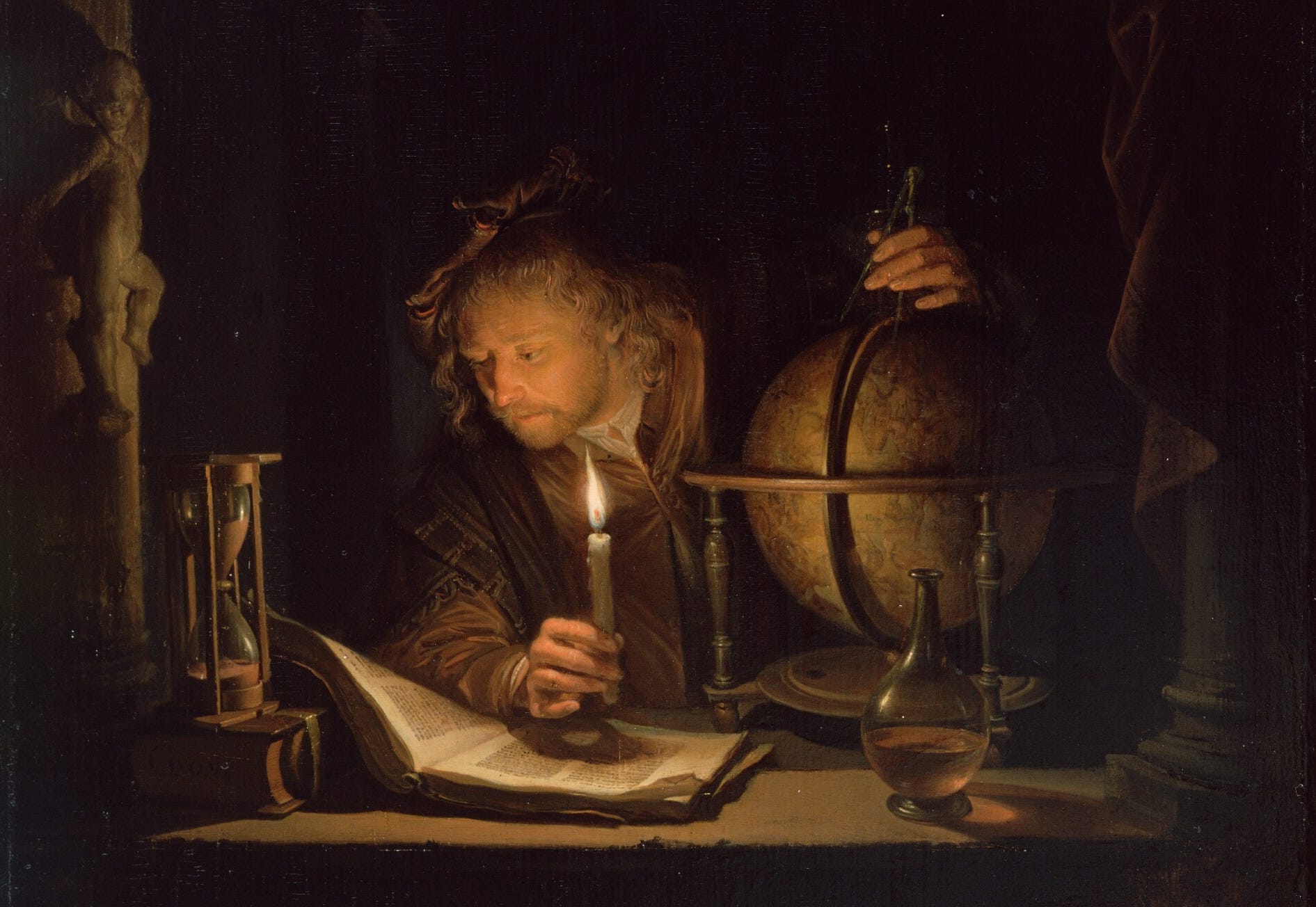
Another phenomenon I think about is sources of light. Two years ago on this site, I wrote five paragraphs about it:
These days I think a lot about light sources. Especially the way light shines through things. But also the ways light bounces off things, or casts shadows.
The materials matter. Light shining through glass can be colored or distorted, slightly or strongly. Light can spark, it can fade, it can bleed through or around things. Light can begin and end. It can be steady. Light can shine through cracks.
The way light brings out color can tell me something about the light. But when I’m looking at color, am I looking at light?
When I look at a shadow, I’m generally seeing an outline of whatever is casting the shadow. The outline can be sharp, fuzzy. A shadow can look somewhat like the original thing, or it can be more like a confusing distortion. The light is on the other side of whatever is casting the shadow. A certain amount of light, or multiple light sources, can lighten or change the shadow. It can also concentrate the shadow, make it dark.
I spend so much time looking at these emanations, consequences, and shadows of the light. And yet what makes me most curious is the source of the light.
Now an addition, from 2025:
In America today, artificial light has washed out our night sky so thoroughly that, across most of this nation, humans can’t see the stars.
—
Simone Weil died partly of malnutrition. The proximal cause was heart failure, but she had greatly restricted her food intake prior, which is widely considered to have contributed to her death. The name she gave this action was solidarity with the French, because her countrymen were starving in occupied France while she lived in exile.
I don’t know if there is a true cure for any of this, or anything to do at all, aside from try to help where it seems possible. Nonetheless, I suspect there are principles. In the last couple of years I’ve encountered Ayurveda; a notion that I’ve heard credited to Ayurveda is that anything consumable can be classified as food, poison, or medicine, depending on circumstances and dose. I encountered a tangentially related notion recently at a lecture by Kathleen Harrison, who has studied curanderos and indigenous spiritual practices in the Amazon. As Harrison put it, there is a principle that when an ill or a poison emerges in the world, a medicine or antidote also emerges.
These metaphors, if that’s the right word for them, drive much of my thinking and my actions.
I’ve spent much of my life creating art and media. One thing I see when I look at the media is that its current afflictions resemble our food afflictions. Poison came up last time I wrote about the media, too.
Is there an emerging antidote?
At the beginning of this post I said that I am trying to gel ideas that are important to me. I am also trying to gel sensations. The word “gel” is one I thought about a lot before I typed it. It took me months to converge on that word. Many synonyms I might have used are unpleasant, kind of gross; the word “coalesce” might work; but I like “gel” better.
“Gel” has an alternate meaning, too: It is not just a verb, but also a noun; in a theatre, a gel is a color filter placed over a light, to shift the light.
•
—
—
The term of art for these laws is “ag-gag laws:” They are laws that exist to prevent publication of records of what it’s like for animals on factory farms. In the United States, some of these laws have been struck down on First Amendment grounds.
One project I recently heard about is called The Real Organic Project, which exists to create new add-on labels to the “organic food” label, to be used by farmers who want “to differentiate organic food produced in concert with healthy soils and pastures.”
As reported by Scientific American and others, “A landmark study on the topic by Donald Davis and his team of researchers from the University of Texas (UT) at Austin’s Department of Chemistry and Biochemistry was published in December 2004 in the Journal of the American College of Nutrition. They studied U.S. Department of Agriculture nutritional data from both 1950 and 1999 for 43 different vegetables and fruits, finding ‘reliable declines’ in the amount of protein, calcium, phosphorus, iron, riboflavin (vitamin B2) and vitamin C over the past half century. Davis and his colleagues chalk up this declining nutritional content to the preponderance of agricultural practices designed to improve traits (size, growth rate, pest resistance) other than nutrition.” The linked article provides other citations as well.
As per a recent warning published by the FDA, there are mounting concerns about both unapproved and fake versions of semaglutide and its cousins.
This really resonated with me and made me think of Jesus’ words in the wilderness: “Man does not live by bread alone, but by every word that comes from the mouth of God.” The way you explore food, light, and the search for something real beneath all the distortions reminded me that the deepest nourishment is spiritual and that it comes from the Word.
Everything is consciousness. Everything you see, smell,hear, feel and taste. Everything.
The easiest way to improve your consciousness is just to improve your surroundings. Plants, beauty, clothes that feel good, etc... The next step is to curate your media and the people you spend time with.
Everything you experience is your spiritual food.
What are you eating?